
Introduction
Bracing for changes from Meta For digital marketers, get ready to adjust your strategy — once again. Some features are new, some targeting options disappear, campaign structures change, and rules of what works changes. meta ads updates
But 2026 is different.
Not a year of incremental tweaks, but you have received significant changes and refinements. At the same time, Meta has launched a set of major updates to its advertising platform that affect all aspects of an advertiser experience — from campaign structures and audience targeting through ad creation, review and delivery.
Marketers that can respond these trends will be placed better than ever to take advantage. Anyone ignoring them — or worse, running their campaigns the same way they were in 2025 — will see their performance slide, their costs rise and rivals getting ahead.
Here, you’ll find everything you need to know about each major Meta Ads update in 2026 — from what changed and why it changed, to how exactly you’ll adapt your strategy to stay ahead.
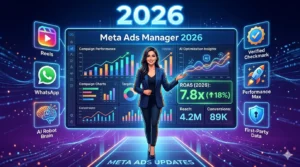
The 2026 Pivot Point For Meta Advertising
To put this year’s updates in context, a wider view of the forces moving Meta’s platforms is helpful.
Artificial Intelligence at Scale : Meta has poured billions into AI R&D, and during 2026 a lot of that investment is coming back to bite every advertiser in some very specific ways. Never before has the platform’s domain knowledge, a function of scale and AI resources been more extensible across all functions between the systems comprising the end-to-end advertising experiences.
The Privacy-First Reality : Digital advertising as we know it has been transformed by global privacy regulations. Third-party cookies are gone. Behavioral tracking is severely limited. The advertising world must evolve to compensate for a world without as much individual-level data in the mix — and those realities have been reflected across platforms at Meta-scale.
The Rise of Conversational Commerce : The quintessential way people shop and decide what to buy has evolved. More and more consumers are choosing to research, inquire and purchase via direct messaging rather than traditional websites and checkout flows. This shows how Meta slowly pushes WhatsApp, Messenger and Instagram Direct into their advertising ecosystem.
Intensifying Competition : Meta cannot simply stand still with TikTok, YouTube, Pinterest and new platforms all preying on its advertising dollars. Meta updates for 2026 are basically Meta’s response to a new competitive advertising backdrop — now with fast(er), smarter, and more powerful platform capabilities than ever before.
All the Major Meta Ads Updates from 2026
1. In your case, running tests with standard settings in other words, your control group is now the outside test
Did you still resist and tried to keep running campaigns in old structure of Meta? 2026 will be the year that pushing against this trend is directly paying your bills. Meta has defaulted to recommending Advantage+ as the structure of choice across nearly all campaign objectives, and the platform actively nudges advertisers toward it when setting up a new campaign.
What Advantage+ does: Advantage+ campaigns cede nearly all decisions related to the campaign over to Meta’s AI. The algorithm decides who sees your ads, where they show, how the budget is distributed and what variations of the creative perform well. Instead of making these decisions, your job as an advertiser becomes feeding the AI with the best inputs you can provide — quality creative assets, clear campaign objectives and the right conversion data.
How to adapt your strategy: The most important thing you can do in an Advantage+ world is to invest creative diversity. Give Meta’s AI 5-10 creative variations per campaign — different images, different video formats, different headlines, call to action — you get the idea. The algorithm can optimise better the more variety you give it.
Just be sure that your Meta Pixel and Conversions API is configured to send clean, whole conversion data! The AI is limited to the data on which it was trained — garbage in, garbage performance out.
2. AI-Generated Creative Tools Are Now Mainstream
After beta-testing its AI creative tools through much of 2025, Meta rolled out the fully-fledged suite in 2026. As of October 2023, every advertiser has access to AI-powered creative generation tools right in Ads Manager at their fingertips.
What’s available:
Text to image — You describe your ad visual and Meta’s AI makes it!
BACKGROUND REPLACEMENT: Automatically replace the backgrounds of products to be in line with diverse campaign themes
Converting Images to Videos — Turn your static images of products into 15 seconds Animated video Ads
Copy variation — AI generates various headline and body text options, all from the same brief
Image Expand — Automatically resize and reshape images (based on different ad placements)
How to adapt your strategy: These will greatly boost your output without increasing production costs. The optimal route is to treat AI-generated variations simply as test material — run them against your manually created ads and use performance statistics for guidance on where to start doubling down.
Then again, don’t rely entirely on AI-spilled innovative. While in 2026, the most successful campaigns will merge AI efficiency with humanity and brand voice. Don’t let those tools replace the creative thinking which got you there — use them to scale what’s working.
3. It put a Verified Business badge on your profile.
This is one of the single biggest changes that have been made to how Meta delivers ads in years as far as their appearance is concerned. This means that advertisers with a verified Business Manager will now see a simple authority marker, a verified business badge next to their name in ad units — this mark is small but extremely effective trust signal every time an ad appears on the users feed.
Why this matters: For the past several years, consumer confidence with regards to online advertising has been waning. Consumers have grown increasingly more skeptical of ads — becoming more knowledgeable to scams and choosier in the businesses people will engage with. The verified badge provides real businesses with a means to instantly validate themselves — and the data backs this up.
Compared to ads without the badge, those with it also have noticeably higher engagement rates, click-through rates and conversion rates. Even with a performance advantage in competitive auctions, this results in both more efficient delivery and cost per result.
How to adapt your strategy: So if your business manager is unverified after doing all this stuff you should be prioritizing verification process before any optimization work. The increased performance from gaining the verified badge on its own is enough to merit the trouble, and verification also allows other platform benefits beyond just getting you a badge.
4. Meta Announces the Roll Out of Performance Max Campaigns
If you are an advertiser on Google it will be very familiar. In 2026, a fully automated goal based campaign across all Meta placements/surface types at the same time is called Performance Max campaigns from Meta.
Key features of Performance Max on Meta: After that, you fill in your campaign objective (purchase, lead generation, store visits… etc.), budget and creative assets. From there, Meta’s AI (which runs on almost all advertising you see across Facebook, Instagram, Messenger, WhatsApp and the Audience Network) sits in the driving seat to find the best combination between audience (i.e. target customer), placement of ad creative and bid that hits your goal more efficiently than before.
The results so far: Brands are seeing great early results with Meta Performance Max — especially e-commerce brands with large catalogs and solid conversion data. This campaign type works extremely well when Meta has huge amounts of conversion data to work with and a variety of creative assets to experiment on.
How to adapt your strategy: Performance max not for everyone However, the more isolating you are, the better, if you have a distinct and measurable conversion goal (ideally one that goes through your pixel) coupled with 50 conversions each week for the algorithm to optimize against. If you are below that checkout threshold, typical Advantage+ campaigns may be better.
For brands that do cross the threshold, we highly recommend testing Performance Max next to your existing campaigns. Test it with a fraction of your budget and benchmark performance against your control campaigns before switching over to this as your mainframe.
5. First-Party Data Is NoW Your Most Valuable Asset
There are some changes that have been on the horizon for many years and in 2026 they have crystallized fully. Third-party data is largely gone. Meta itself can no longer do very much with its behavioral targeting. Those that are winning are advertisers who have built their own first-party data assets.
What first-party data refers to in this scenario: core set of your data, classes will include metrics that result from your email list, pricing for customer phones numbers, user information of website visitors captured from the Meta Pixel and Conversions API, User Info of app users and engine symbol release. Data that your customers have shared with you directly — and it is the most powerful targeting resource available in a privacy-first world.
The way Meta employs your first-party information: You load your customer list by way of uploading that data as a Custom Audience on the Meta platform, where it takes your data then crosses it with all of its user database to find you in Facebook and Instagram. So you can either directly show them ads, or you can use them to seed a Lookalike Audience — where you find new people with similar traits as your best customers yet.
How to adapt your strategy: Priority, business-wide — not just a marketing tactic — to collect first-party data. Each interaction a customer has with your brand is a chance to ethically gather data; this could be through an email signup form, purchase confirmation, loyalty program, lead magnet and app registration.
Invest in the proper CAPI implementation so your data from pixels is present and correct even in browsers blocking cookie based tracking. Data is the fuel that drives Meta’s AI optimization systems, and clean, comprehensive conversion data provides the best crankcase oil here.
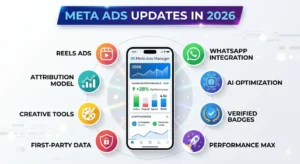
6. Reels Ads Are the New Top Placement
Short-form video has finally taken over as the dominant form of social media content, and Meta fully embraces that reality on its platform in 2026. Reels placements represent the biggest part of ad inventory across both Facebook and Instagram now, and Meta’s algorithm is already favoring Reels content in user feeds.
What this means for advertisers: If you’re not building out vertical video specifically for Reels placements, then you are fighting over a diminishing piece of the priciest inventory. Well-Executed Vs Static-feed Reels ads deliver lower CPM and higher engagement rates every time
Breakdown of a high-converting Reels ad: The first 1–2 seconds are all that matter. Users scroll through content at lightning speed — Your ad needs to stop the thumb right away with a short blunt impactful opening, an unexpected statement, a daring question or an immediately engaging action.
Keep it short and sweet — 15-30 seconds is optimal for most goals. Add captions or text overlays because many people watch the videos with sound turned off. And finish with a clear and direct call to action.
How to adapt your strategy: Confirm a slice of the creative budget to spend directly on Reels ad production. Indeed, even personal-feeling smartphone-shot clips can beat big-studio productions in this format — as long as it is native, i.e., does not look like an advertisement.
7. WhatsApp Advertising Has Gone Mainstream
A niche advertisng format, two years ago, has in 2026 become one of the key — and highest performing — ad products at Meta. Click-to-WhatsApp ads and WhatsApp-integrated campaign experiences have gone mainstream — and so too the results.
Here is when advertising WhatsApp works best: The intent to convert is unbelievably high when a person clicks on a WhatsApp ad and initiates a chat with your business. They have now taken the step from passive viewer to active prospect by engaging directly — they’ve raised their hands. Companies that are managing these conversations effectively, are seeing conversion rates several orders of magnitude higher than traditional landing page campaigns.
The complete WhatsApp Ads Ecosystem in 2026:
Facebook and Instagram feeds Click to WhatsApp ads
- Short-form video: WhatsApp Reels ads harness conversations
- The shopping might be made simple via in-chat product catalogs on WhatsApp
- Well, here we go! Automated conversations that do all the selling for you
- Frictionless WhatsApp payment integration in available regions
How to adapt your strategy:
If you have not tried Click-to-WhatsApp ads, start today! Start with a basic campaign sending users into a WhatsApp chat, have your team (or bot) ramped up to respond to enquiries and measure conversion through to sales for real ROI tracking.
If you have any type of high-touch sales processes — real estate, financial services, education, customized product, etc., WhatsApp advertising could quickly become your #1 channel.
8. New Attribution Windows and Reporting
When it comes to 2026, we need to carefully think about the start of attribution windows and what’s been used as a basis for reporting (while Meta has updated its attribution windows and historical report methodology). The changes include:
Extended view-through attribution – Gives more credit to ads who have been exposed to a user without any click and understand the significance of branding.
Cross-channel attribution modeling: Generate greater insight about how Meta ads perform against other marketing channels.
Predictive analytics — AI-driven predictions reflecting how the campaign is going to perform in the following days according to current trends
Incrementality measurement — Fresh tools for accurately measuring the incremental effect of Meta advertising beyond last-click attribution
How to adapt your strategy: With these new attribution options, check your campaign reporting setup. The default attribution settings may indeed not be the best suited for your business model. Your analytics setup is your closest partner — work together to make sure that you are measuring what matters, which is not what any platform reports but actual business value.
Effective Meta Ads Strategies For 2026
That brings to another aspect you understand the individual updates. Another is creating a holistic strategy that brings all of them together. A meta advertising framework for success in 2026:
Set up: Business Manager + Pixel and Conversions API correctly set-up + solid first party data collection system.
Campaign Type: Advantage+ or Performance Max campaigns varied creative inputs with specific conversions goal.
Creative Strategy: A large number of creative tests against static images, Reels videos and AI-generated variations. To fight ad fatigue, refresh creative every 2-3 weeks
Audience strategy: First-party data Custom Audiences play a central role in targeting. Lookalike Audiences based off of your best customers. Meta AI for Prospecting: Broad audience campaigns.
WhatsApp API : Convert Leads to Businesses 📞. Facebook Shops and product catalogs to streamline e-commerce. Support for native checkout where available for maximum conversion rate.
Measurement: Multi-touch attribution model. Regular incrementality testing. Weekly performance reviews with monthly strategic modifications.
Big Blunders To Avoid In 2026
Fighting the algorithm — When you fight advantage+ and want rigid manual control over targeting and placements, performance will be worse and cost higher. Don’t compete with Meta’s AI, work with it as well.
Creative fatigue sinks in faster — Because AI can execute ads more efficiently to ever larger audiences, if creative is neglected. The creative is stale has now become one of the top reasons that campaigns are starting to perform poorly.
Minding your own data — More advertisers with little first-party data background are stuck as Meta’s general targeting continues to put them at a disadvantage. Start building your list today.
Video skipping – Inventory is in the Reels placements. Not doing video means much higher prices for less and less static ad space.
Ignoring WhatsApp — The conversion rates are simply too high. Only those who test Click-to-WhatsApp ads are not missing out on huge amounts of revenue.
Conclusion
Meta Ads in 2026 rewards advertisers who will take on (and also action) change, make the right investments and trust Meta’s AI to take that input and optimize campaigns to the max.
There are some pretty updates this year, but nothing that is impossible. Every price drop Meta made as of 2026 enables the advertisers who know how to read the tea leavs and took action. Some of the AI creative tools result in reduced production costs. Advantage=better optimisation with less manual work. Advertising is WhatsApp has higher converging rate. More trust and better performance with a verified badge.
The thing is not whether those changes would influence your advertising — they are already influence it. The question is whether you will adjust quickly enough to exploit them as advantages.
Stay informed. Stay flexible. And keep testing.
Tags:
#MetaAdsUpdates2026 #MetaAds2026 #FacebookAds2026 #MetaAdvertising2026 #FacebookMarketing2026 #MetaAlgorithm2026 #DigitalMarketing2026 #MetaAdsTips #FacebookAdsStrategy #MetaAdsChanges #SocialMediaMarketing2026 #MetaAdsManager #FacebookAdsCampaign #MetaMarketingUpdates #OnlineAdvertising2026